Cinematography School
Theory, technique & visual craft for the independent filmmaker.
CHAPTER TWO
Lenses & Optics
A lens is a point of view. Focal length does not just determine what fits in.
Focal Length
Focal length, measured in millimeters, describes the distance from the optical center of a lens to the sensor when focused at infinity. It determines two things: the angle of view (how much of the scene you capture) and the spatial compression (how objects at different distances appear relative to each other).
Wide lenses (short focal lengths) exaggerate the distance between near and far objects. A face shot on a 16mm lens looks distorted because the nose is disproportionately closer to the lens than the ears. Wide lenses also exaggerate movement — a walk toward camera feels faster.
Long lenses (telephoto) compress space. Objects that are far apart appear stacked on top of each other. A 200mm lens shooting a person walking down a long street makes it look like the buildings, cars, and people behind them are right on their back. This compression removes the sense of depth and creates a flattened, graphic quality.
The 50mm lens on a full-frame sensor roughly matches human field of vision and spatial perception. It is the most psychologically neutral lens — the audience is least aware of the camera’s presence. Any departure from 50mm is a statement.
| Focal Length | Angle of View | Character | Common Use |
|---|---|---|---|
| 8–14mm (ultra-wide) | Very wide | Distorted, immersive | POV, action, establishing |
| 16–24mm (wide) | Wide | Environmental, energetic | Action, doc, interiors |
| 28–35mm (mild wide) | Natural-ish | Classic street perspective | Masters, handheld drama |
| 50mm (normal) | Near human eye | Invisible, honest | Neutral drama, dialogue |
| 85mm (portrait) | Mild tele | Flattering, intimate | Close-ups, emotional scenes |
| 100–135mm (tele) | Compressed | Detached, voyeuristic | Surveillance, crowd shots |
| 200mm+ (long tele) | Very compressed | Extreme isolation | Wildlife, action details |
Depth of Field
Depth of field (DoF) is the range of distance from the camera within which objects appear acceptably sharp. A shallow depth of field means only a thin slice of the scene is in focus — the background and foreground blur into soft bokeh. A deep depth of field means nearly everything from near to far is sharp.
DoF is controlled by four variables, each of which you can manipulate independently. Understanding how they interact gives you creative control over what the audience focuses on.
Shallow DoF isolates your subject, drawing the eye to what’s sharp and letting everything else fall away. It creates intimacy, emphasizes emotion, and simplifies busy backgrounds. Deep DoF keeps the entire environment in play, allowing the audience to choose where to look. It’s used in compositions where multiple planes of action matter simultaneously — staging in depth, as championed by directors like Orson Welles and filmmakers working in the deep-focus tradition.
| Variable | Shallower DoF | Deeper DoF |
|---|---|---|
| Aperture | Wider (lower f-number: f/1.4) | Narrower (higher: f/11, f/16) |
| Focal Length | Longer (85mm, 135mm) | Shorter (24mm, 35mm) |
| Subject Distance | Closer to camera | Further from camera |
| Sensor Size | Larger (full frame) | Smaller (crop, phone) |
“Shallow depth of field is a cliché. Use it with purpose, or not at all.”
Aperture & T-stops
Aperture is the adjustable opening inside a lens that controls how much light reaches the sensor. It is measured in f-stops: f/1.4, f/2, f/2.8, f/4, f/5.6, f/8, f/11, f/16. Each full stop halves or doubles the amount of light. A lower f-number means a wider opening, more light, and shallower depth of field.
F-stops are a geometric ratio (focal length divided by the diameter of the aperture). Two lenses at f/2.8 should theoretically transmit the same amount of light — but in practice, light is lost as it passes through multiple glass elements inside the lens. Some lenses lose more light than others.
T-stops (transmission stops) account for this light loss. A T-stop measures the actual amount of light transmitted through the lens, not just the geometric opening. Cinema lenses are rated in T-stops rather than f-stops because exposure consistency between lenses matters on a film set. If you switch from one lens to another and both are set to T2.8, the exposure will match. With f-stops, it might not.
For photography and independent filmmaking with still camera lenses, f-stops are fine. For multi-camera shoots or any production where lens changes must be seamless, T-stops provide the consistency you need.
Lens Character & Anamorphic
Beyond focal length and aperture, every lens has its own character — the subtle optical qualities that give images a particular feeling. This includes how the lens renders bokeh (the quality of out-of-focus areas), how it handles flares when light hits the front element, how sharp or soft it is wide open, and how it renders color and contrast.
Modern lenses are designed to be clinically sharp, high-contrast, and flare-resistant. Vintage lenses often have lower contrast, softer edges, more pronounced flares, and optical imperfections that many cinematographers find beautiful. Shooting on vintage glass gives images an organic, textured quality that is difficult to replicate in post.
Anamorphic lenses use a special cylindrical element that squeezes a wider field of view onto the sensor, which is then un-squeezed in post (or by the projector). The most common squeeze factor is 2x, which turns a 2.39:1 widescreen image into a standard sensor area. Anamorphic lenses produce distinctive characteristics: horizontal lens flares, oval bokeh, subtle edge distortion, and a unique sense of depth. They are the signature look of epic cinema.
Anamorphic lenses are traditionally expensive, but modern options from companies like Sirui and Vazen have brought anamorphic shooting within reach of independent filmmakers. Anamorphic adapters that attach to spherical lenses are another affordable entry point, though they come with trade-offs in sharpness and ease of use.
A 50mm f/1.8 ‘nifty fifty’ costs under $150 and produces images as cinematic as lenses ten times the price. Master one lens before collecting many.
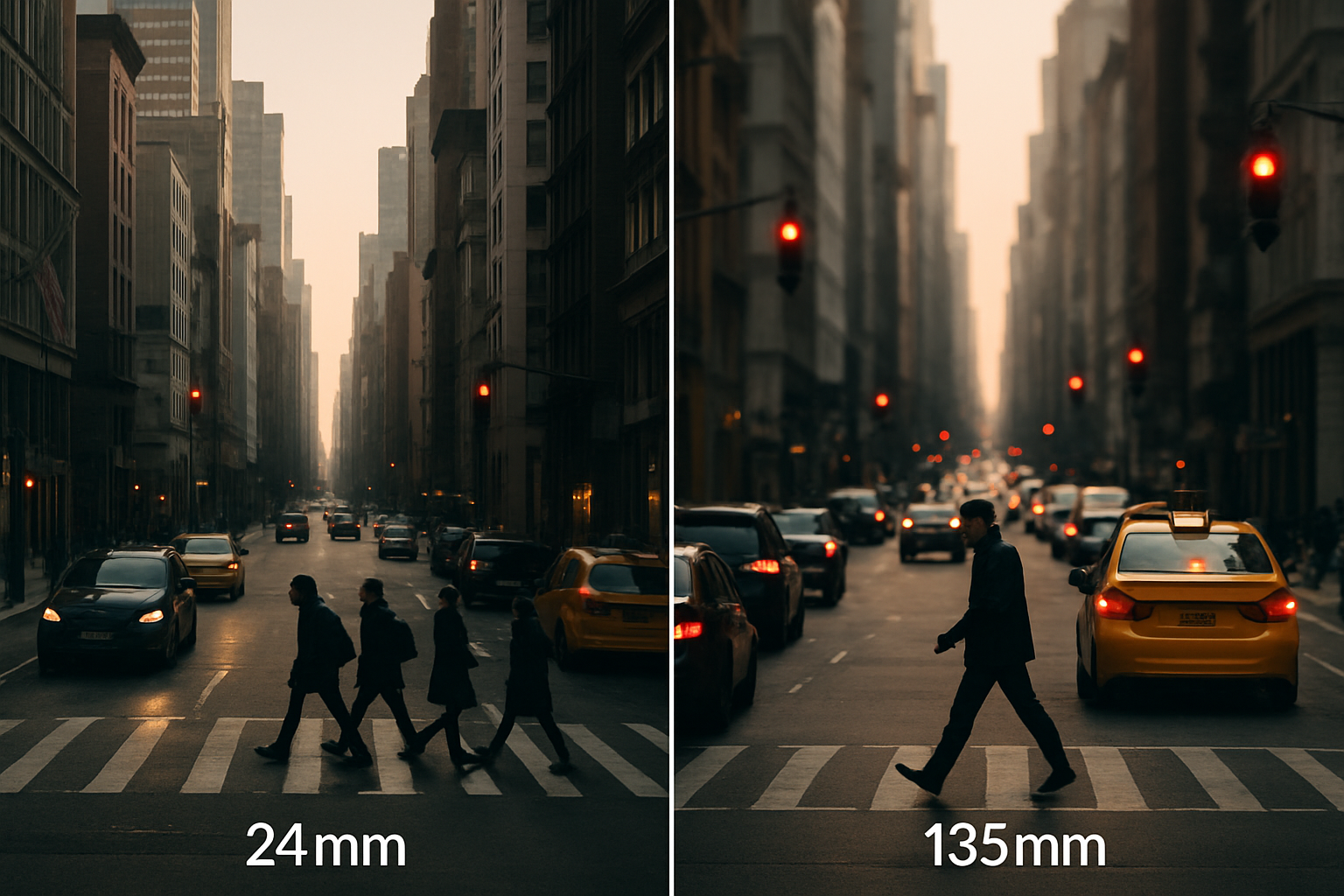
Wide angle (24mm) vs. telephoto (135mm) compression
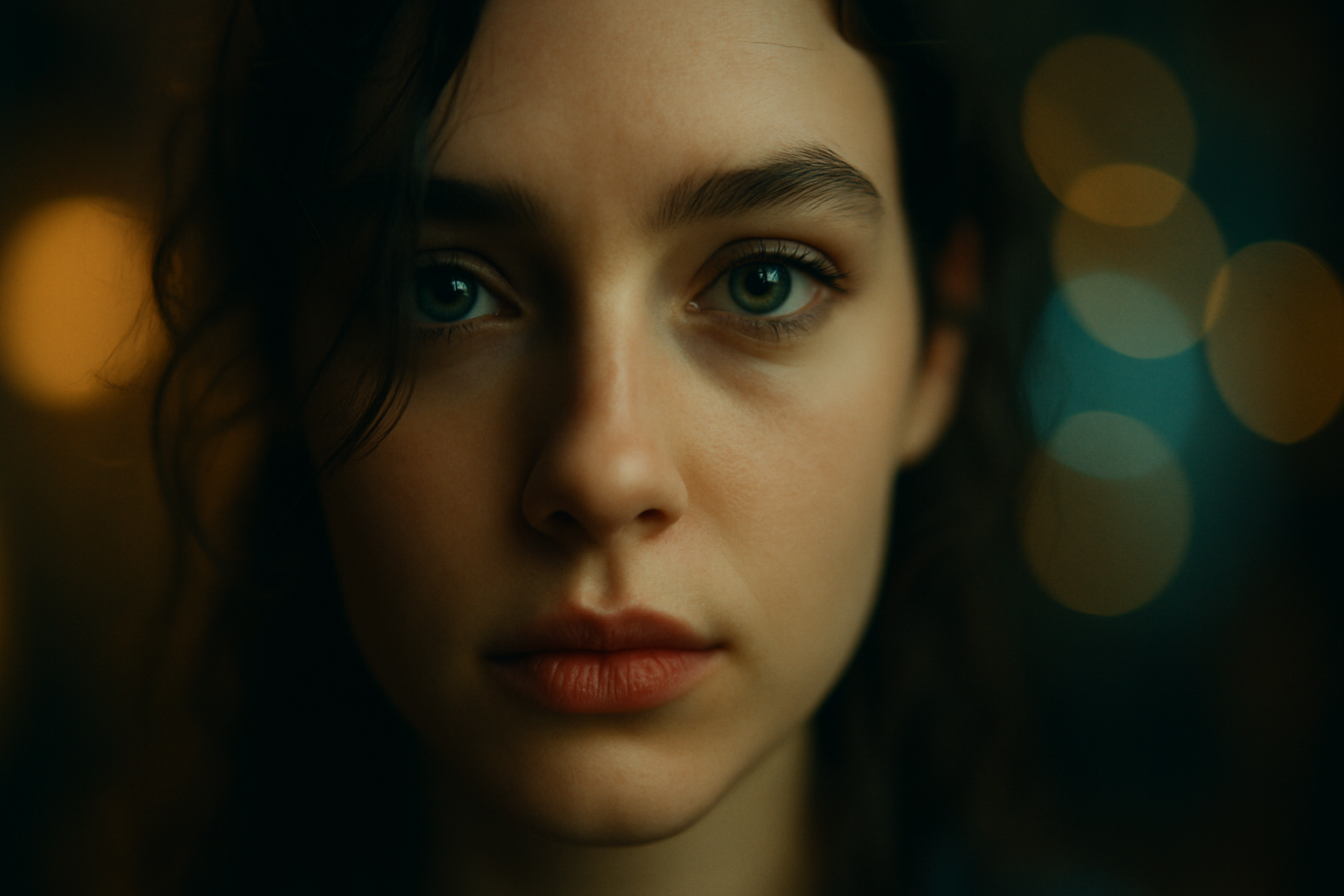
Shallow depth of field at f/1.4 — anamorphic bokeh